





Cryptocurrency news Tron launched as a content-distribution project and has become the settlement layer for a large share of the world’s USDT, processing roughly $150 billion to $190 billion of stablecoin transfers a week. Josh Olszewicz of Canary Capital breaks down how the network’s economics work and what stablecoin regulation could do to the thesis. You’re reading Crypto Long & Short, our weekly newsletter featuring insights, news and analysis for the professional investor. Sign up here to get it in your inbox every Wednesday. Note: The views expressed in this column are those of the author and do not necessarily reflect those of CoinDesk, Inc., CoinDesk Indices or its owners and affiliates.
Breaking down Tron, the settlement rail for stablecoins by Josh Olszewicz, portfolio manager and head of trading, Canary Capital
The Tron
TRX $0.3388
network has quietly become one of the most heavily used blockchains in the digital asset market through a singular focus on speed, cost and settlement efficiency. A layer-1 blockchain (where transactions are recorded, validated and finalized), Tron has become the dominant settlement rail for stablecoins, particularly Tether’s USDT, processing billions of dollars in value transfer every day. Launched in 2018, Tron began as an ERC-20 token on Ethereum before migrating to its own independent blockchain. Its founding vision centered on decentralizing content distribution; over time, however, the network’s primary use case shifted substantially. Today, Tron is best understood as global payment infrastructure, one that has become particularly attractive in emerging markets where low transaction costs and fast settlement matter more than cutting-edge programmability. Tron uses a delegated proof-of-stake (DPoS) consensus mechanism.
Under this system, TRX holders stake their tokens to gain voting power and use that power to elect 27 Super Representatives, the validators responsible for producing blocks and maintaining the network. Because block production is concentrated among a limited, elected set of validators rather than distributed across a broad network of participants, Tron can achieve fast confirmation times and low computational overhead. Stablecoins and the payments use case
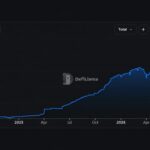
The single most important development in Tron’s evolution has been its emergence as the leading settlement network for stablecoins. A substantial share of global USDT circulation now resides on Tron, and this characteristic separates Tron from many of its layer-1 peers: rather than competing primarily on DeFi innovation or consumer applications, Tron has positioned itself as digital payment rails for dollars. That positioning shows up clearly in the network’s usage data. According to Tron’s blockchain explorer, weekly transaction counts on Tron have climbed to record highs, recently approaching 100 million transactions per week, even as the average onchain transaction fee has fallen to around seven cents, a multiyear low.
Weekly active addresses, a measure of unique wallets transacting on the network over a seven-day period, have also been climbing toward record levels, reflecting broad and sustained usage rather than a narrow base of activity. Stablecoin transfer volume on Tron has grown alongside this activity, recently running at roughly $150 billion to $190 billion per week.
TRX utility and economics
TRX is the network’s native token, » …
About Post Author





More Stories
Latest Circle lands $100 million from Binance to ramp up global USDC expansion in Cryptocurrency
Latest Stablecoin salaries can leave workers paying to access their wages in Cryptocurrency
Latest Grove Basin enables instant stablecoin liquidity for tokenized treasuries in Cryptocurrency