





Cryptocurrency news A prop firm in Chicago just posted margin, and it wasn’t dollars or Treasuries. Prime Trading delivered USDC to Marex as initial-margin collateral for CFTC-regulated cleared derivatives, the first transaction under a program Marex announced on July 16. The workflow has now run end to end inside the US clearing system, from a customer posting the stablecoin to an FCM funding the position in dollars. The transaction also raises a broader question: how does stablecoin collateral actually work, who are the key counterparties, and how solid is the regulatory basis? 1.
What did Marex actually announce? Marex Group (Nasdaq: MRX), the clearing and financial services group, said clients can post USDC, the dollar stablecoin issued by Circle, as initial-margin collateral for cleared derivatives regulated by the CFTC.
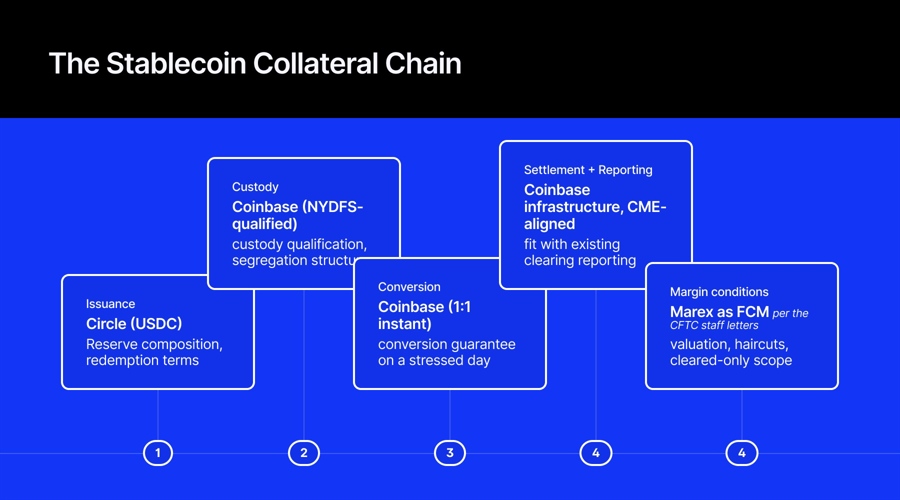
Per Marex’s own release, Coinbase provides NYDFS-qualified custody, 1:1 instant fiat-to-USDC conversion, and bespoke reporting infrastructure aligned with CME requirements. Instead of describing stablecoin margin in general terms, the announcement names three specific components: custody, conversion, and CME-aligned reporting. 2. What is an FCM, and why should a CFD broker care?
A futures commission merchant is the US clearing intermediary: it holds customer margin, guarantees its customers’ trades to the clearinghouse, and sits under some of the strictest client-money rules in American finance. A CFD broker never touches this plumbing directly.
But US regulators test collateral innovation at FCMs first, and what gets normalised in FCM margin today has tended to surface in prime brokerage terms, PSP stacks, and client funding conversations a few quarters later. 3. What did the first transaction actually look like?
Prime Trading LLC, a Chicago proprietary trading firm, posted USDC to Marex as margin collateral. Marex then delivered cash to fund the firm’s positions. “Stablecoin collateral is moving from concept to production,” said Liz Martin, Coinbase’s VP of Markets, in the release. The two legs stay separate throughout: USDC serves as the collateral asset an FCM may hold against exposure, while the funding itself stays in dollars. 4. What is initial margin, and why does the collateral type matter?
Initial margin is the good-faith deposit posted when a position opens, as distinct from variation margin, the daily settlement of gains and losses. What an FCM may accept as initial margin is tightly controlled, because collateral is only useful if it holds its value and can be liquidated fast under stress. Every new collateral type has to answer the same three questions: how is it valued, how quickly does it convert to cash, and who holds it in the meantime. The Marex-Coinbase workflow maps custody, conversion, and reporting onto exactly those three questions for USDC. 5.
What is a CFTC no-action letter? A no-action letter is a written promise from CFTC staff not to recommend enforcement action, as long as a firm meets stated conditions. Think of it as a nod from the building inspector rather than a building permit. It carries real weight, but it is not a Commission rule. It skipped notice and comment, and it binds only the staff who signed it.
About Post Author





More Stories
Latest Coinbase and Marqeta Bring 24/7 Stablecoin Card Spending to Millions of Merchants in Cryptocurrency
Latest Borderless.xyz report finds stablecoin payments beat bank FX rates in Cryptocurrency
Latest XRP Ledger adds new controls for banks, stablecoins and tokenized funds in Cryptocurrency